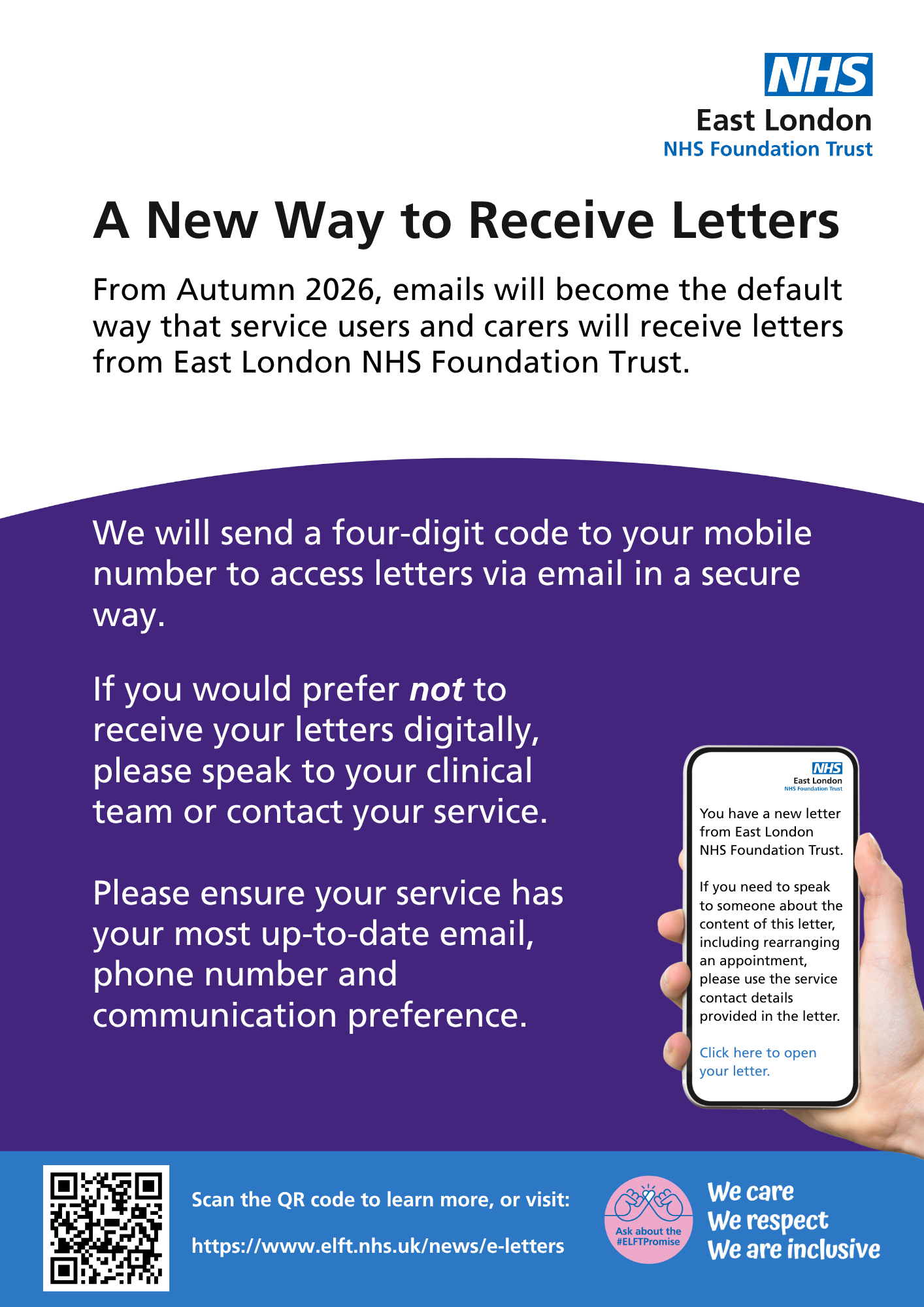
For a select group of services across the Trust, email correspondence will become the default way that service users and carers will receive details about upcoming appointments or other important communication.
By receiving emails, service users and carers will be able to receive communication from their service quicker than previously, rather than waiting several days for postal delivery. This also means that service users and carers will be able to access letters at any time from a smartphone, tablet or computer without the need to keep paper copies, which are more likely to be delayed or lost in transit.
Although emails will become the default approach, service users and carers will continue to have a choice about how they would like to receive correspondence, whether this is by post, by email, or a mixture of both.
If service users or carers would like to opt out of receiving email correspondence and continue to receive physical letters, they are advised to speak with their clinical team to make the necessary arrangements.
How will digital letters be delivered?
-
After a service has sent a letter, service users and carers will receive a text message with a 4-digit PIN code.
-
Service users and carers will receive the letter via email. In this email, they will be prompted to select ‘Click here to open your letter’ at the bottom of the page.
-
A pop-up box will appear, asking the individual to enter the PIN they received via text message.
-
Once entered, the letter will open. It can then be downloaded and saved if required.
If service users or carers do not access the link in the email within 48 hours of delivery, they will receive a physical letter instead.
The rollout of default email correspondence will take place in various phases, with phase one beginning in autumn 2026. The below services will not be included in phase one, and will be completely unaffected at this stage:
-
Children's Services
-
Older People's Services
-
Forensic Services
-
Learning Disability Services
In total, there will be three phases of the rollout. The Trust aims to conduct phase two and three in the first half of 2027, with further details provided in due course.
If you have any questions, do feel free to contact your service.