
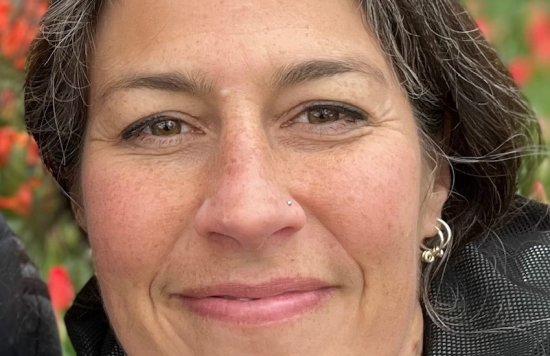
Jennifer steps into the role alongside long-standing lead Paul, dedicating part of her week to supporting ELFT’s environmental ambitions.
We spoke with Jennifer to learn more about her background, her passion for climate action, and her hopes for driving sustainability across clinical practice.
Q. Can you tell us a bit about yourself and your new role?
Jennifer: I’m a Psychotherapist in the Newham Wellbeing in Schools (WINS) Team within CAMHS. Alongside my clinical role working primarily with adolescents, I’ve now taken on the position of Clinical Lead for Sustainability and Climate Action, working alongside Paul Lomax, who has been leading this work for several years.
Q. What inspired you to apply for this sustainability role?
Jennifer: I’ve always been drawn to climate, botany, soils, trees and woodland, right from childhood. Even during my psychology degree in the U.S., half my modules were things like soils, woody plants, pest management and biology of trees.
She went on to train and work as a chartered landscape architect where her primary client was the Environment Agency, later running forest school sessions with young children before retraining as a psychotherapist.
Jennifer: My career has always sat between wellbeing, people, and the natural world. This role finally brings those strands together.
Q. What is your vision for embedding sustainability into clinical practice at ELFT?
Jennifer: Sustainability is already happening within existing Trust priorities, just not explicitly. Work around belonging, prevention, community-based care, and staff wellbeing all carry sustainability benefits. My vision is to help make those links clearer and ensure sustainability becomes a visible strand woven through models of care, rather than a separate initiative.
She will focus on two workstreams:
-
Embedding sustainability into models of care
-
Ensuring sustainable thinking shapes procurement and commissioning decisions
Q. How does environmental sustainability relate to patient care?
Jennifer: Climate change is already affecting people’s health. It’s a multiplier for existing conditions, like asthma, and in areas with limited green space, such as Newham, it affects people’s ability to exercise, build social connections, and support their wellbeing.
ELFT’s work around population health, prevention, and reducing inequalities is inherently climate-aligned. It means we are working to design our models of care to meet the needs of people, pounds and planet, recognising that environmentally sustainable healthcare will also be fair, equitable and lean.
Q. What role can the Climate Network and Green Teams play?
Jennifer: There’s so much going on - teams improving bike use, reducing waste, expanding green spaces, using nature in therapy, addressing asthma and air pollution. The more we share good practice across the Trust, the more momentum we build. Highlighting what’s working creates positivity and hope, which is so important in sustainability work.
Q. What are the biggest challenges ahead?
Jennifer: Shifting political narratives can make sustainability harder to prioritise nationally. But ELFT’s commitments - to population health, reducing inequalities, prevention - remain strong. These areas naturally link to environmental sustainability, so there is opportunity even within challenge.
Q. And finally, what excites you most about the future?
Jennifer is particularly inspired by ‘doughnut economics’, a model that balances human wellbeing with planetary boundaries.
Jennifer: I’d love us to develop an ‘ELFT doughnut’, making sure no one in our communities falls below a minimum standard of wellbeing, while ensuring our services don’t exceed environmental limits. It brings together health, social justice, and sustainability in a really powerful way.
If you have ideas or want to get involved in the Climate Network, Jennifer warmly invites you to get in touch via jennifer.hawkes3@nhs.net and elft.greenelft@nhs.net