
Written by Saleem Haider, Digital People Participation Lead
Digital skills and affordability are a critical aspect to thrive in modern society, which is increasingly becoming a ‘digital-first’ economy.
The UK government is striving for the NHS to catch up with other industries and has set out the NHS 10-year plan to accelerate the health system shift from ‘analogue to digital’.
However, the levels of digital exclusion in the UK have been stubbornly persistent, and it has never been more important to identify who can confidently consume digitalised care – and those who are in need of support and guidance.
In light of this, East London NHS Foundation Trust has published a new report, Promoting Digital Access Amongst People Using Mental Health Services, examining digital equity for the adult population accessing mental health services across ELFT’s region of East London, Luton and Bedfordshire. The study has been inclusive with the survey design, project work and report results have been supported by service users in the People Participation Digital Community.
Digital Access linked to marginalised communities
The report finds significant challenges within the mental health community where digital exclusion was strongly associated with older age, lower income, sensory impairments, long-term physical health conditions, and diagnoses such as psychosis and bipolar disorder.
Digital Access Report key findings
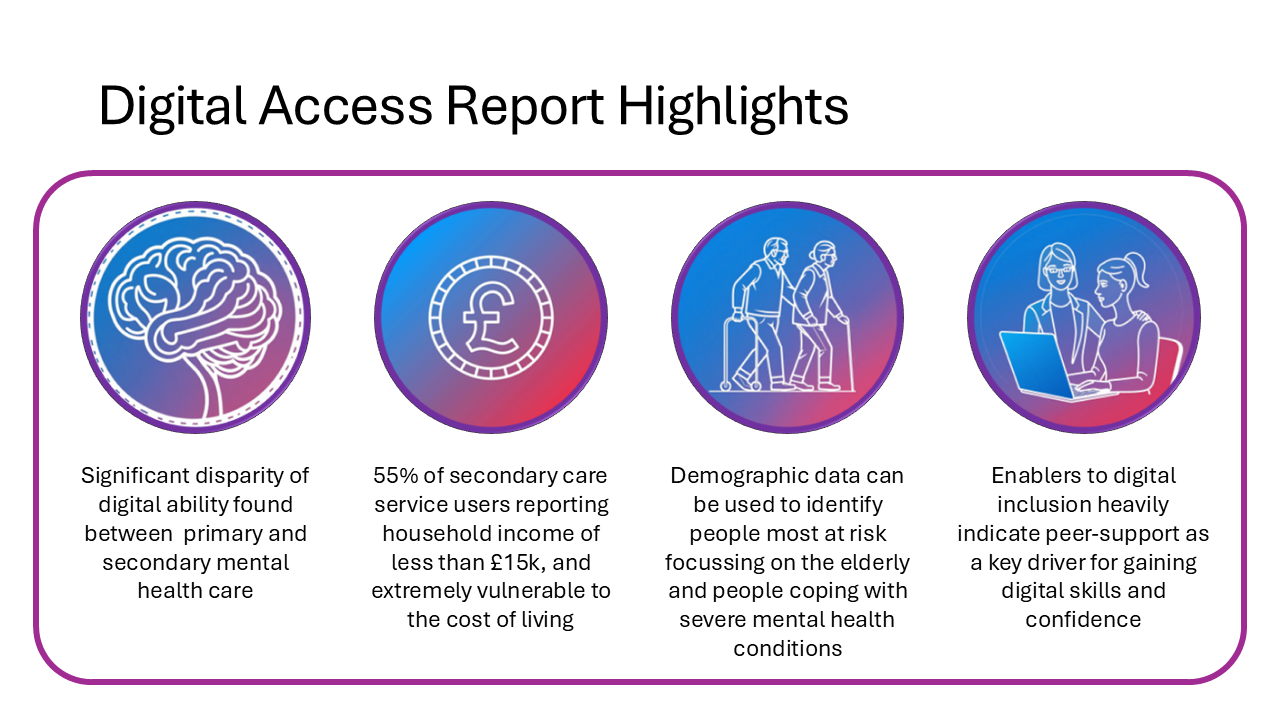
There are considerable risks of deepening inequalities in mental health care services as healthcare access move online. The report concludes with recommendations for driving digital inclusion where there is growing body of evidence demonstrating digital access and confidence is a super social determinant of health, where people with higher levels of digital literacy are more likely to respond to self-care and are more active in managing their health.
How to learn more?
To read the full report, please visit our webpage - Promoting Digital Access in Mental Health Services