
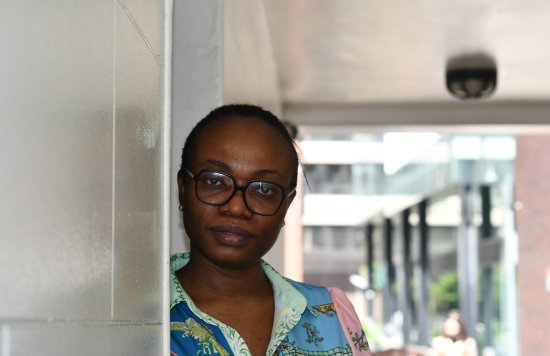
As part of our series of interviews with People Participation Workers, Robert Hunter (People Participation Lead for the North East London Mental Health, Learning Disability and Autism collaborative) spoke with DK to find out how she came into the field of People Participation.
Hey DK, could you tell us about yourself?
My name is Daukoru Jonah but everyone calls me DK. I like to describe myself as a ‘creative’ and I help other creatives to find their way on social media and I help them create from within. My friends say: “DK sees patterns” and it’s true - that’s how I’m wired. I see patterns and things that help people not just find themselves but also to realise their own creative potential!
I love coaching. I wish I could do it more, and by coaching I don’t mean sports! Hahaha! I don’t do sports at all! For me coaching is all about personal development. I love books, I love podcasts and social media!
What is it about social media and traditional media that you enjoy?
I think for me, it’s fascinating! Back in 2011, I had a blog with a ridiculous name. I wonder if it still exists… but I was so curious about how people shared information and the fact people were able to be so creative and share knowledge and creativity on their own terms in their own way and words. The fact that this freedom existed was liberating. I struggled in school and I have always struggled in learning despite having three degrees; just because we are equal, does not mean we have the same freedom of expression. I remember lecturers saying to me: “You have an exceptional mind, but it doesn’t translate into the work you produce”. So I fell into social media accidentally, during a time when I was being moved from hospital to hospital trying to get a diagnosis. Social media became my escape. I was finding information, peers – I was able to explore this world free from creative constraints.
For me creativity is not about the best tools, the best paints, the best vocabulary… Creativity is about understanding everyone has something, a creative dream, within them that wants to be created.
My creative dream is to start a stationary business!
You mentioned a bit about your early life and your struggles before you found your online outlet and online self. Could you tell us a bit about the non-virtual DK?
I am an introverted extrovert. I like people but I also very much don’t like “people” sometimes. I used to find solace in reading outside around people. I got into a routine where I would always try to read ahead of time for the next academic year, because I always knew there’d come a point during the academic year where I’d have a health crisis or a deterioration of my own health due to my chronic illness. So I’d pre-emptively play catch up to make up for any lost classes. It was just the norm for me to constantly have to adapt, but in academia, this wasn’t accepted or welcomed. This meant that my grades initially were always poor because I wasn’t able to express myself in the way I wanted to in the time I needed.
It wasn’t until I realised that I learned better alone than in groups, that my brain clicked! When I leaned into the way I needed to learn rather than the ways people wanted me to learn, I was far happier and that has led my ethos through life since.
It’s definitely a lesson about not only being yourself but also trusting yourself!
Exactly! Then everybody starts paying attention! I heard a quote recently: “Submit it the way you want to and don’t make changes other people want. So at the end of the day you are confident that you did it YOUR way. If it succeeds it succeeds, if it fails it fails, but you did it your way.”
That has been my mantra for years. I process information slowly sometimes or at other times, it feels like the speed of light. I just trust myself.
During your journey, when you realised that doing things your way, the world falls into place, did you find out about anything else you enjoyed or disliked?
I fell in love with stationary despite not having the best handwriting! I loved the way it felt when it was right!
I am also a Christian and I love studying the bible! I created a group for like minds to come together to have conversations without preaching. Just good conversations about faith and the bibles teachings. It feels so honest and unique.
I do not like sports!! Hahahah
I love photography but not professional photography! I just like taking photos with my phone!
I’m not an outgoing person but I love being around people and bringing people together. But I keep my circle small.
I also love karaoke and music! I joined a clubhouse group during lockdown called “Karaoke for those who can’t sing” and we had SO much fun!! It was just amazing!
How did you come to be involved in PP?
I fell into it accidentally! I was having group therapy in Talking Therapy, and on the last day, the therapist told me about PP and I instantly fell in love with it. It got me out of the house for the first time since the COVID pandemic. My sister worked in A&E during COVID and told me not to leave the house and I took that literally for three years.
PP got me to leave the house whilst feeling safe. Going for those sessions and learning what PP is about, made me realise how important it is for people like me to play an active role in how the NHS is run. It’s not just about changing things, it’s about making sure there is a voice in the room and advocating for those who can’t advocate for themselves.
PP is a service I wish I knew about earlier. There is a communication issue in the NHS around making sure service users are aware of the services they are eligible to use or receive. If I had heard about this far sooner, it'd been good. There are so many options that service users and carers don’t know they have. It shouldn’t be on them to ask.
But what I love about PP is how non-judgemental it is. Having a voice to be frustrated or to be excited – just knowing your voice is heard is amazing. I love what PP stands for.
Do you have an insights into how you have found it, not just as a service user, but also being in discussions and groups, working behind that curtain.
Before joining PP, the perception was that the NHS was frustrated, tired and shunned accountability. And that makes you come into this with a negative view and feeling ready for a fight. But very quickly you realise that you’re working with people, not an organisation. People who ALL want change. What I see now is this feeling that there is no communication and that this ‘us and them’ mentality is everywhere.
Being able to come together, without judgement, to ask questions and answer questions is so important. So many stories you wouldn’t otherwise hear without the spaces that PP holds for everyone. Another thing is realising just how LONG everything takes!! Like this podcast! How many meetings and teams happen just to start up a project!!
Thousands of people trying to make the best out of an imperfect machine. But we need to remember that the healthiest population is one that can advocate for itself – it’s not service users against service providers, we’re all on the same team!! Listen to each other!
I struggled being moved from service to service, not being taken seriously and being dismissed. Had I been listened to earlier, I’d been diagnosed with Autism far earlier than the 10 years it took to be taken seriously. The system is fractured, not broken, it’s not too late to mend it.
With all your experience of seeing the good and the bad of NHS services, as someone who was almost forced to be assertive and become an advocate for yourself, what advice would you give someone to help them advocate for themselves.
Trust your gut instincts. We know when things are good or bad. Trust yourself.
Don’t allow yourself to get ambushed by things, prepare for appointments and track your own health. I use AI to help me get the most out of my appointments and to keep me on track. It helps me create questions and make the most of the short time I’m given. Lead your own healthcare and be proactive in your health, not just a reactive participant.
Also get yourself an advocate!! Or confide in a trusted friend or family member – having someone who knows your will and your wishes, what you’d say yes to or no to and having someone to talk to is so important.
Based on what you said earlier that the system is fractured not broken, what are the three things you’d mend, change or get rid of to start that process?
I’d update the NHS app straight away. Our population is becoming more online and more reliant on apps. The NHS app needs to be relevant and keep up with other apps that may have more nefarious intentions. It has to have symptom trackers and an in-house AI built in to help you triage yourself or to find specific answers to things without trawling through hundreds of web pages!
The NHS app should and could do much more than to just show you your health records. It should be the all-in-one-care-plan that everyone keeps asking for! It should connect to smart watches or your phones to track steps, heart rhythm, etc… It’s arguably the one time that an app really should have access to all that data! Opt in or opt out, but it should be an option. It should act as a health navigator to really help you.
I’d also make sure there is a post-diagnostic team, available to help people who have been given a diagnosis to make sure they don’t fall through any cracks – to offer support and understanding and to make sure they’re on hand to answer questions about what this all means and what to expect next.
Thank you, DK. We’re at the end of our interview now, and at this point I like to ask people for some words of wisdom, could you share some words with us?
So, I’m Nigerian, and I always use Nigerian words when I’m doing things and one I love is “Productivity starts with Jaga-Jaga”, which is a word that means messy, chaotic or cluttered! What I’m saying, is that creativity is messy – it needs to be messy! Creativity should be chaotic at first. From Chaos come clarity and from clarity comes structure.