
Training
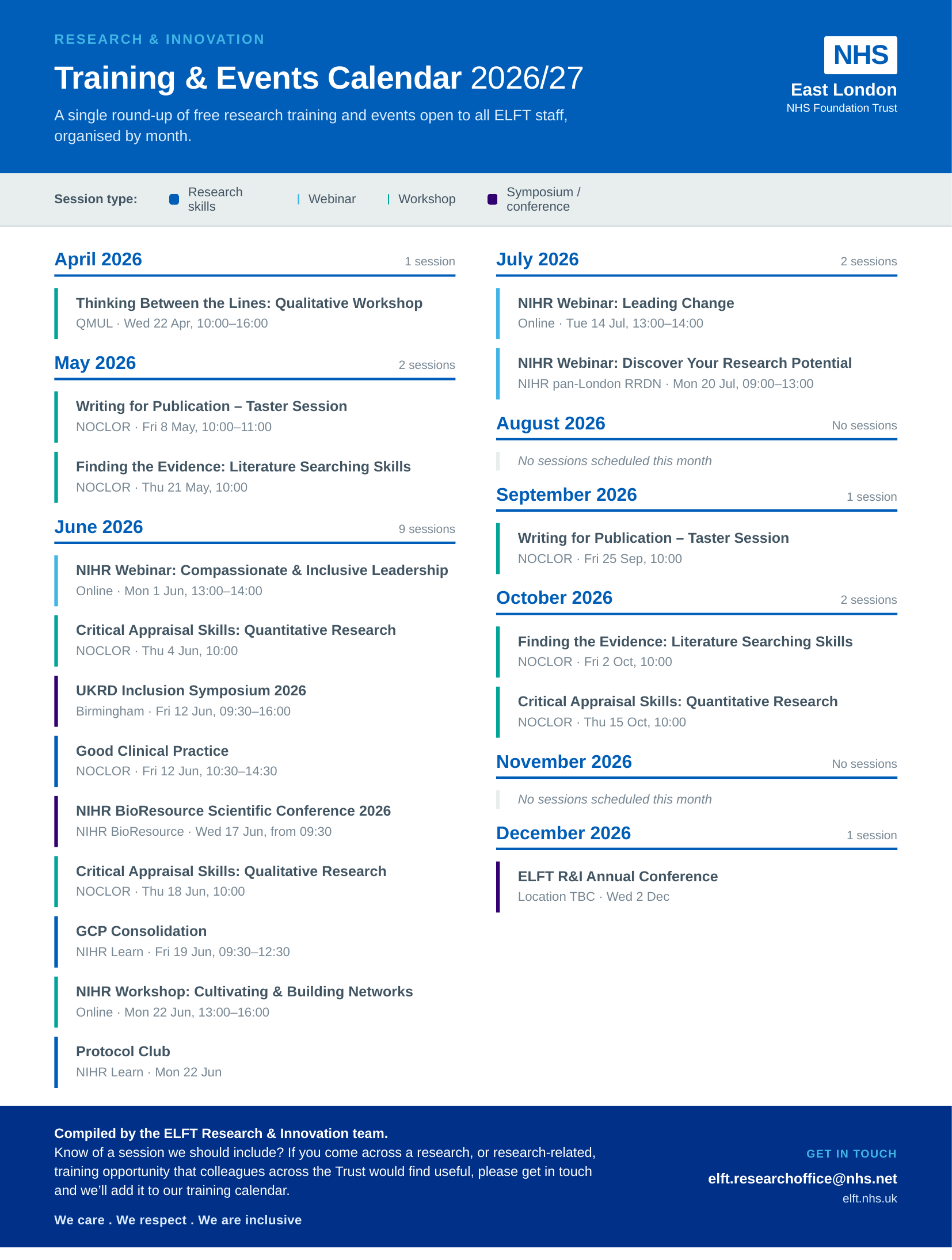
Noclor is offering this workshop designed to address the benefits of getting published, as well as the barriers Researchers may encounter.
Delegates will learn how to structure a paper and how to avoid common pitfalls. The session is interactive and will includes two practical activities.
By the end of this session delegates will have:
Discussed the value of writing for publication
Explored topics for potential publication
Focused on targeting journals
Reflected upon writing conventions
Considered and understood the processes involved in preparing an article for publication
Date / time: 25 Sept 2026, 10:00
Noclor is offering this workshop designed to introduce the concept of literature searching through Healthcare Databases Advanced Search (HDAS) interface, to demonstrate some of the features of the healthcare databases and to offer basic skills required to search these databases.
This includes: Healthcare Databases- Searching Medical, Nursing, Psychological, Complementary and Allied Medicine, Health Administration and Health Management Databases with links to full-text articles of over 1500 journals.
Intended for: Staff who would like to gain basic skills to search for evidence-based literature.
Skills required: Basic PC and mouse skills.
Date / time: 02 October 2026, 10:00
Critical appraisal skills are crucial to implementing evidence-based healthcare. This one-day course is designed by the Library and Knowledge Team for Trainees in Psychiatry. It includes two ½ day workshops on quantitative and qualitative research evidence. The purpose of these workshop is to introduce critical appraisal, to describe the major features of quantitative and qualitative research and to appraise a quantitative and a qualitative research paper.
Date / time: 15 October 2026, 10:00
Critical appraisal skills are crucial to implementing evidence-based healthcare. This one-day course is designed by the Library and Knowledge Team for Trainees in Psychiatry. It includes two ½ day workshops on quantitative and qualitative research evidence. The purpose of these workshop is to introduce critical appraisal, to describe the major features of quantitative and qualitative research and to appraise a quantitative and a qualitative research paper.
Date / time: 05 Nov 2026, 10:00
The Trust hosts an annual conference showcasing Research & Innovation @ ELFT.
The event, which is usually attended by hundreds of people, is open to all staff, service users, carers and members of the public. The half-day conference consists of brief presentations on a wide range of research projects that are being conducted in the Trust, ranging from epidemiological studies to clinical trials and qualitative work.
Our next conference will be held on Wednesday 02nd December 2026. Local venue and timings TBC.
Find out more here.
Recorded Webinars and Online Resources
Getting Involved in Research
Have you, or someone you know, ever wondered what health research is and what it involves? Do you want to know what the common myths are and explore ways to get involved? Would you like to hear from people who have taken part in health research and learn why they volunteered?
The course runs for three weeks and new learners can join at any time.
To find out more about the course and to join, please follow the link to the course homepage.
This webinar is part of the Activating Research series, presented by NIHR ARC North Thames Academy. This training session provides an overview of what research is, how to become a research leader and opportunities for getting involved in research through your trust and organisation. By the end of the session, you will: (1) have a better understanding of the importance of research; and (2) be able to identify the pathways to developing a research project and potentially career. Click on this link to access the recording of the session.
Sage has developed a series of seminars aimed at students and early-career researchers. Find the series here.
This webinar is part of the Activating Research series, presented by NIHR ARC North Thames Academy. This webinar provides an introduction to research planning and the support that is available to researchers from the NIHR. This includes:
- the role of the Research Partnership Team (RPT) in the collaboration in designing responsive applied research;
- the assistance available to researchers from the NIHR Research Design Service (RDS) London through the various stages of research design and funding applications; and
- the Clinical Research Network (CRN) supports workplace development and delivering studies.
The Associate Principal Investigator Scheme, delivered by NIHR, aims to develop health and care professionals to become the Principal Investigators (PIs) of the future.
The Associate PI Scheme is a six month in-work training opportunity, providing practical experience for health and care professionals starting their research career.
People who would not normally have the opportunity to take part in clinical research in their day-to-day role have the chance to experience what it means to work on and deliver an NIHR portfolio trial under the mentorship of an enthusiastic Local Principal Investigator (PI). A Principal Investigator is an individual responsible for the conduct of a research study at a site.
Associate Principal Investigators receive formal recognition of engagement in NIHR Portfolio research studies through the certification of Associate PI status, endorsed by the NIHR and Royal Colleges.
Find out more HERE.
This webinar is part of the Activating Research series, presented by NIHR ARC North Thames Academy. The presentations cover different routes for disseminating your findings, the different topics of applied research (clinical, public health, social care), how to showcase your work, and how to include patients and research participants in writing up and sharing research. Click on this link to view the training session.
NHS England has produced a research toolkit that offers practical information to support staff in developing research and driving innovation within nursing team.
The guidance includes:
- how to recognise key components of research leadership
- where and how to access research and innovation support
- how to develop, measure and evidence growth in research engagement across teams
- how to reflect on individual research leadership and create a research development action plan
- how to access communities of practice and share ideas with likeminded leaders
Find the tooklit here.
The recording of the recent webinar, hosted by the NIHR Research Delivery Network, sharing best practice in abstract writing and poster presentation is now available. Watch here.
Developing a Research Grant
Watch the 'Developing a Research Grant' segment from our recent training session here.
Videos played and time stamp:
- Choosing a Study Type (05:28 - 09:29)
- NIHR Research Support Service Animation (11:07 - 13:30)
Setting up a study in the NHS: Sponsorship
Watch the 'Setting up a study in the NHS: Sponsorship' segment from our recent training session here.
Videos played and time stamp:
- HRA Approval Animation (09:11 - 11:35)
Setting up a study in the NHS: Study Management & Support
Watch the 'Setting up a study in the NHS: Study Management & Support' segment from our recent training session here.
Running a Study Well
Watch the 'Running a Study Well' segment from our recent training session here.
Research Methods and Tools
According to the World Health Organisation, climate change poses a fundamental threat to human health. These threats are associated with changes in the physical environment, social structures and economic systems that impact health across the globe. Healthcare research, technological development and innovation can support the move to environmental sustainability and shape sustainable healthcare in the future.
Two webinars, hosted by the Sustainable Healthcare Coalition, discuss aspects of environmental sustainability associated with designing and implementing healthcare research and innovation.
Sustainable Clinical Trials COP webinar: The clinical trial carbon calculator
This webinar discusses emissions related to clinical trials and explores the use of the clinical trial carbon calculator. It considers how researchers can anticipate carbon inputs associated with study design, and utilise carbon data in analysis.
Watch the webinar here.
Building environmental considerations into the evaluation of health interventions
This webinar considers sustainability within a care pathways approach. It focuses on factoring sustainability into processes related to health technology assessments, considers how a broader approach, considering sustainability across a range of indices, can be integrated into the spectrum of decisions associated with health interventions, innovation and research.
Watch the webinar here.
Thematic Analysis is a widely used and popular method of analysing qualitative data in many different disciplines. It is a type of analysis which focuses on identifying patterns in meaning across different sources of data to answer a research question or explore a concept.
This course uses a hands-on and practical approach to introduce you to how to do thematic analysis within healthcare research. Across 3 sessions we will introduce the philosophy and paradigm of qualitative research, before using real research data to understand how to manage, code, analyse and report data within this method.
All three sessions have been recorded and can be accessed online:
Session 1: Click here to access the recording to the session
Session 2: Click here to access the recording to the session
Session 3: Click here to access the recording to the session
Narrative Synthesis is a type of approach used to systematically review findings from multiple research studies. This approach primarily focuses on the words/text and can be used to answer a wide range of research questions. The training session firstly starts with placing narrative synthesis into a wider context of meta-synthesis. It covers its background, related definitions as well as different types of meta-synthesis. The later part of the training session provides an in-depth look at narrative synthesis. The session has been recorded. Click here to access the presentation slides.
This free online webinar will:
- Introduce the concepts of reproducibility and replicability in research
- Show examples of replication problems from research in psychology, epidemiology, and health care
- Explain how mis-use of statistics can produce false conclusions
- De-mystify the idea of “statistical significance”
- Show simple examples of good practice in the use of statistical hypothesis tests
- Illuminate us in how to detect some types of questionable statistical methods in published research
To stream the recording, please click here.
This webinar, presented by NIHR ARC North Thames Academy, is part of a series focusing on adapting study methods for remote qualitative research. Recently online focus groups have become the new ‘normal’. This webinar focuses on carrying out focus groups using a range of digital platforms. To access the recording of the session, please click here
This webinar, presented by NIHR ARC North Thames Academy, is part of a series focusing on adapting study methods for remote qualitative research. In this session, Marnie Howlett (LSE) discussed lessons learnt from having to move her international fieldwork in Ukraine online, highlighting the new forms of knowledge that come from looking at the field through a ‘Zoom’ lens. To access the recording of the session, please click here
This webinar is aimed at Early Career Researchers. It covers the following topics:
- What is open science?
- How can we make our research open?
- Why is open science important for early career researchers?
- What are the benefits of adopting open science practices?
- What are the challenges in adopting open science practices?
The webinar was hosted by the NIHR ARC North Thames Academy Early Career Researchers Network. To access the recording of the session, please click here.
Essential Study Management Skills
Good Clinical Practice (GCP) training is a key requirement for individuals involved in clinical research and is designed to ensure that those involved in conducting a trial are qualified by education, training and experience to perform their respective tasks. There are several options:
- National Institute for Health Research (NIHR) Online GCP training courses are free and available to NHS, UK universities, and other publicly funded organisations conducting and supporting clinical research. Courses are accessed via their learning platform NIHR Learn.
- MRC offers an e-learning module Good research practice: Principles and guidelines. This course is intended to support local induction material for new starters, act as a reminder and entry point into the GRP document for more established staff, and will take about an hour to complete.
- Self-guided online course from London School of Hygiene & Tropical Medicine.
To support researchers with the attribution of study activities, the NIHR has developed the attribution e-learning tool on NIHR Learn.
The Schedule of Events Cost Attribution Tool (SoECAT) is a tool for use with non-commercial research to ensure that site-level costs are appropriately attributed according to AcoRD principles at the time of application for research funding and hence to ensure that site-level Research Costs are met via that funding.
SoECAT guidance module on NIHR Learn
A network of AcoRD specialists to assist with understanding the requirements for a SoECAT. If you're unsure who you need to speak to, please email the NIHR Study Support Service Helpdesk at supportmystudy@nihr.ac.uk.
An eLearning course from MRC introducing MRC's expectations for good research practice. It is a series of 10 bite-sized e-learning modules accompanied by a collection of resources to help researchers get to grips with the principles of GDPR and the common law of confidentiality for research. You must create an account to complete the training. Visit the website to learn more about the training provided.
In this guidance you will find information on the principles of consent (both ethical and legal).
NIHR offer a virtual course; dates of the next in-person course will be listed once released.
Patient and Public Involvement in Research
Varied Voices is an NIHR learning module, now available on BMJ Learning, that discusses effective strategies to create inclusive research environments.
The short course (around 45 minutes) helps researchers, healthcare professionals, and others:
- understand diversity and inclusion in research and the benefits of incorporating diverse perspectives
- explore barriers discouraging involvement in research and strategies to overcome them.
It drew on learnings from the NIHR’s Race Equality Public Action Group (REPAG), which gives underrepresented communities a stronger voice in shaping priorities for research.
NIHR presents a one hour on demand talk on the theme "Addressing the diversity challenge: Using data to identify the right research locations".
Health research regulators across the globe are encouraging researchers to increase the diversity of people taking part in clinical trials.
The Health Research Authority (HRA) and the Medicines and Healthcare products Regulatory Agency (MHRA), the World Health Organisation (WHO) and the Food and Drug Administration (FDA) have all issued or updated inclusion and diversity guidance in the last 12 months. With these changes ongoing, one thing is certain: inclusive research is better research.
In the UK our data capabilities are rapidly expanding and creating new ways to target research locations that offer opportunities to engage diverse populations.
Access the talk HERE.
NIHR presents a one hour on demand talk on the theme "Strategies for growing patient recruitment and retention through inclusive research design and delivery".
Patient-centred research leads to more relevant and effective research, ultimately improving patient outcomes and experiences. It also helps achieve trial goals and builds evidence for improving future health and care.
In this webinar the expert panel will explore how inclusive and accessible approaches to trial design and delivery can expand your patient demographic, improve retention rates and speed up recruitment.
The panel host, Professor Margaret Ikpoh, NIHR National Settings Lead for Primary Care, leads the panel as they share and explore practical strategies for addressing barriers to participation and delivering research closer to communities.
Access the talk HERE.
This free, online toolkit by the Centre for Ethnic Health Research and NIHR CRN East Midlands provides researchers with a framework to improve participation in research, making it more diverse and inclusive. It will help you develop more relevant research questions, consider the engagement of different ethnicities in a more structured way and provide tips on better participation and dissemination of research findings. Visit the webpage to access it.
This webinar is part of the Activating Research series, presented by NIHR ARC North Thames Academy. This webinar provides an introduction to Patient and Public Involvement and Engagement (PPIE) and co-production. It also broadly covers what it is, who is involved, why it is important, and how it can be done effectively. Access the recording of the session.